Zhixing Program European Practice Team Visits China-CEEC Institute
Recently, the European Practice Team of Tsinghua University's "Zhixing Program" visited the China-CEEC Institute, an important research hub empowered by Chinese think tanks. From a youth perspective, the team witnessed the vivid practice of China's connectivity with foreign countries, gained insights through practice, and strengthened their original aspirations through exchanges.
As China's first overseas think tank independently registered in Europe focusing on Central and Eastern European (CEEC) studies, the China-CEEC Institute has been deeply engaged in key fields such as regional and country-specific research on CEEC, China-Europe relations, and Belt and Road cooperation since its establishment in 2017. It has achieved remarkable results in academic publishing, policy research, think tank dialogues, and talent training. The Institute has continuously built a bridge for Sino-foreign academic exchanges, released a series of research reports, organized high-end academic forums, promoted joint publishing and international cooperation, providing solid intellectual support and professional policy consultation services for the high-quality development of the Belt and Road Initiative and the deepening of cooperation between China and CEEC countries.
During the forum and exchange session, experts from the Institute gave a systematic introduction to the current situation and prospects of pragmatic cooperation between China and Hungary. In recent years, cooperation between China and Hungary has continued to deepen in fields such as economic and trade investment, scientific and technological innovation, international collaboration, and theory and technology application, with high-tech industry cooperation emerging as a new highlight. People-to-people and cultural exchanges have flourished: seven Confucius Institutes and Sino-Hungarian bilingual schools in Hungary have operated efficiently, serving as important carriers for language communication, people-to-people bonds, and cultural mutual learning, and laying a solid foundation for youth exchanges and talent training between the two countries.
Through this forum and on-site visit, members of the practice team gained a more comprehensive and in-depth understanding of the opportunities, potential, and practical challenges of China-Hungary cooperation. They all stated that this exchange took them out of the classroom and connected them with frontline think tanks, allowing them to intuitively feel the solid progress and broad space of cooperation between China and CEEC countries, and deeply understand the bridge role and historical mission of think tanks in international cooperation. As young students, they will integrate their professional knowledge with national needs, continue to pay attention to China-Hungary and China-CEEC cooperation, and strive to grow into compound talents with an international perspective, a good understanding of regional national conditions, and the ability to serve China's opening-up drive, contributing youth power to Sino-foreign friendship and the high-quality development of the Belt and Road Initiative.
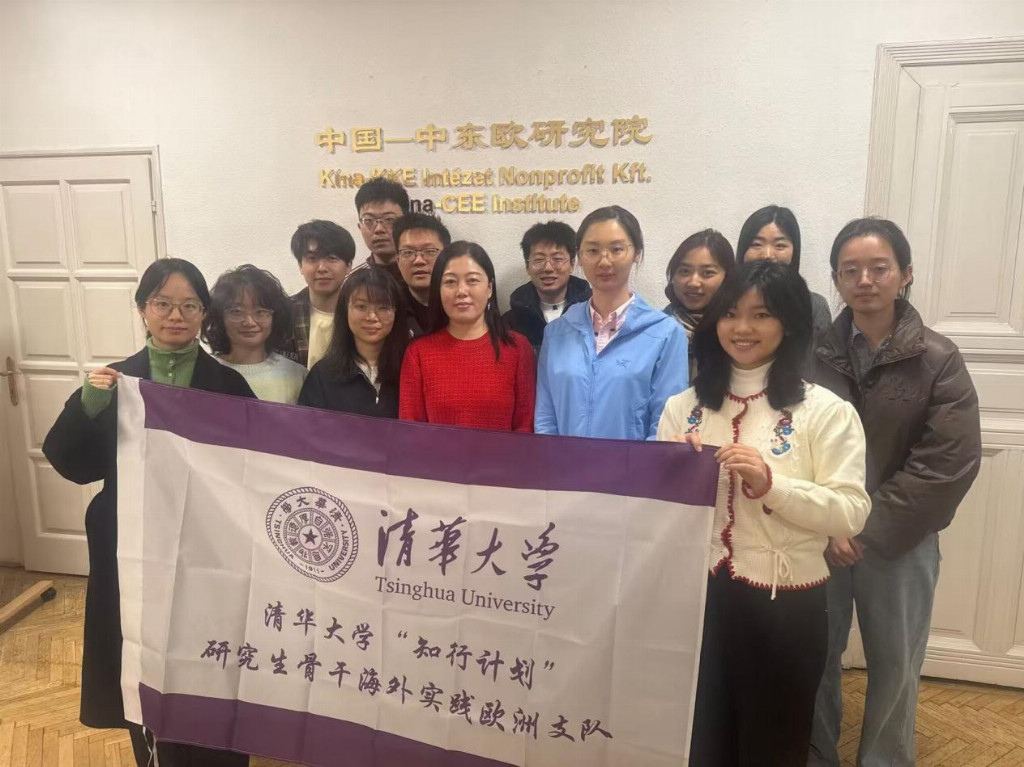
The practice team took a group photo at the China-CEEC Institute.